
Integrated CO2-EOR and post-EOR dedicated CO2 storage: Demonstrating the value of coupled system and optimal incentive structures
Abouzar Mirzaei-Paiaman, Larry W. Lake, Lorena G. Moscardelli
International Journal of Greenhouse Gas Control, 149, 104543, 2026
https://doi.org/10.1016/j.ijggc.2025.104543
Study Summary
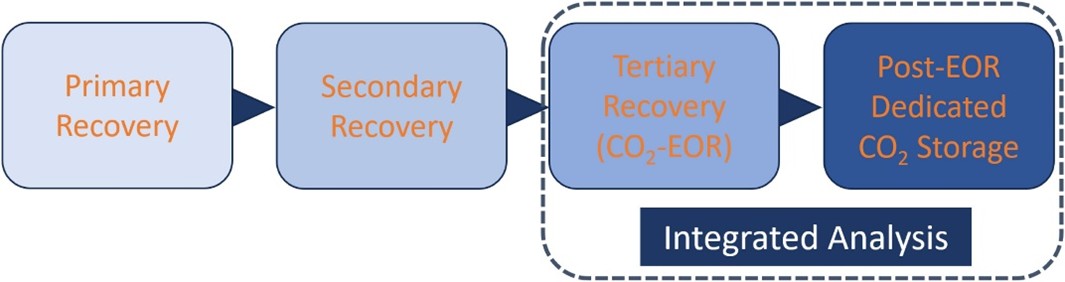
Injecting anthropogenic CO2 into oil reservoirs provides the benefits of enhanced oil recovery (EOR) and reduced atmospheric CO2 levels. After a CO2-EOR project ends, operations can transition into dedicated CO2 storage, wherein CO2 injection continues without further oil production. We adopt an integrated approach that jointly considers the EOR and post-EOR phases, with the objective of maximizing benefits across the entire project timeline. We demonstrate the value of the integrated system using a case study from a San Andres reservoir in the Permian Basin, West Texas, and also use it to provide first-order estimates of optimal carbon storage incentives for both phases. Optimality is defined as the level of incentive that aligns economic returns with environmental gains. Using a compositional simulation model, we compared two integrated strategies under identical conditions: 1) continuous CO2 injection and 2) CO2-WAG (Water-Alternating-Gas), each followed by a post-EOR CO2 storage phase. The CO2-WAG approach yielded higher oil production but resulted in lower CO2 storage compared to continuous injection, with the reduction in CO2 storage observed during both the EOR and post-EOR phases. A similar trend was observed in terms of net CO2 emissions, reinforcing that CO2-WAG is less favorable from a climate perspective. Economically, the relative attractiveness of each strategy was highly dependent on the level of incentives. At lower incentive levels, the CO2-WAG strategy was more profitable, both during the EOR phase and over the entire integrated system. As incentives increased, certain scenarios emerged where CO2-WAG remained more profitable only during the EOR phase, while the strategy involving continuous CO2 injection became economically superior over the full integrated system. In some cases, continuous injection was consistently more profitable in both the EOR phase and the integrated context. These findings underscore the importance of evaluating CO2-EOR and post-EOR storage as a single, integrated system. Economic superiority during the EOR phase alone does not guarantee optimal outcomes across the full project period. Moreover, compromising CO2 storage during the EOR phase can make it implausible to achieve maximum storage potential in the integrated system. These results also highlight the critical role of well-designed incentive structures in aligning economic and environmental goals.
Why is this research important and why do the results matter?
- The post-EOR phase presents a valuable opportunity for substantial CO2 storage and for reducing the overall emission intensity of CO2-EOR operations.
- Treating CO2-EOR and dedicated CO2 storage as separate processes risks overlooking critical interdependencies, thereby limiting the ability to optimize both economic and environmental outcomes.
- There is a strong interdependence between carbon storage incentives across the EOR and post-EOR phases.
Link(s):
Mirzaei-Paiaman, A., Lake, L. W., and Moscardelli, L. G. 2026. Integrated CO2-EOR and post-EOR dedicated CO2 storage: Demonstrating the value of coupled system and optimal incentive structures. International Journal of Greenhouse Gas Control, 149, 104543. https://doi.org/10.1016/j.ijggc.2025.104543

