
Optimal CO₂ storage management considering safety constraints in multi-stakeholder GCS projects: A Markov game perspective
Jungang Chen and Seyyed A. Hosseini
International Journal of Greenhouse Gas Control, 2026
https://doi.org/10.1016/j.ijggc.2026.104682
Study Summary
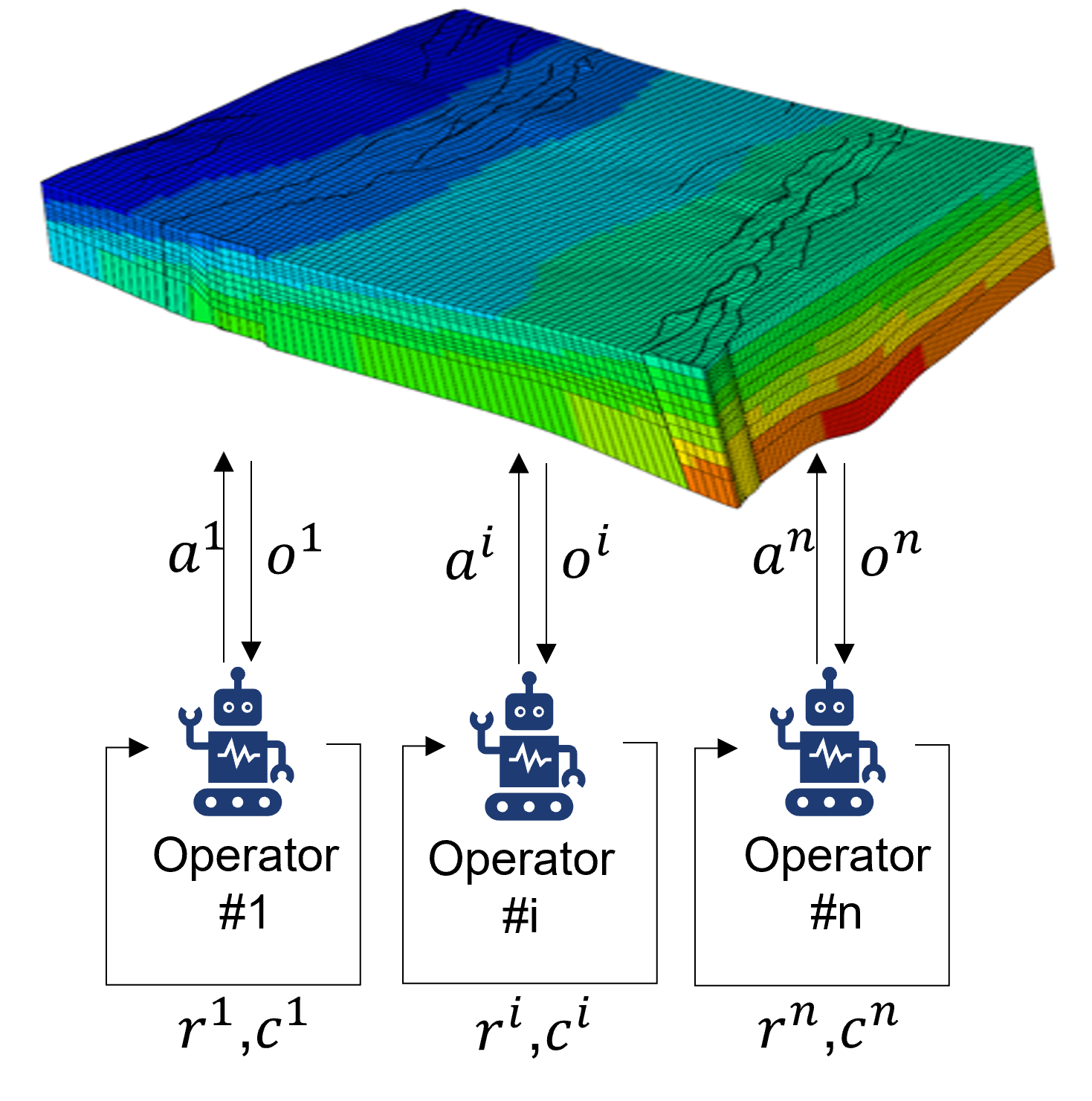
Geological carbon storage (GCS) is increasingly planned at basin scale, where multiple operators lease different pieces of land (a project site) but inject CO₂ into connected geological formations. Each operator may act based on its own objective, but these uncoordinated actions can lead to system-level inefficiencies, e.g., underutilized reservoir capacity, reduced subsurface land use, and so on. This study looks at how multiple storage operators can make better decisions when their projects interact underground. The problem is framed as a Markov game, a way to model decision-making when several participants act at the same time and each participant’s actions can affect the others. The study uses multi-agent reinforcement learning, a type of artificial intelligence in which multiple decision-makers learn from repeated trial and error, to test different coordination strategies. These include fully cooperative strategies, where operators work together; fully competitive strategies, where each operator focuses on its own project; and mixed strategies, where some operators cooperate while others do not. Results show that coalition structure can strongly influence individual and system outcomes: full cooperation can improve system-level performance and safety, while decentralized competition may lead to less efficient use of shared storage resources. The decision-support framework developed in this manuscript helps evaluate coordination, safety, and resource-use trade-offs for future multi-operator CO₂ storage projects.
Why is this research important and why do the results matter?
- Introduces a Markov game approach to model decision-making for multi-operator carbon storage projects.
- Helps evaluate how fully cooperative, fully competitive, and mixed coalitions affect individual and system performance.
- Provides a decision-support framework for coordination, safety, and resource-use trade-offs in basin-scale GCS.
Link(s)
Chen, J., and Hosseini, S. A., 2026. Optimal CO₂ storage management considering safety constraints in multi-stakeholder multi-site GCS projects: A Markov game perspective, International Journal of Greenhouse Gas Control, Volume 154, 104682, https://doi.org/10.1016/j.ijggc.2026.104682.

