
From Pixels to Processes: Linking Automated Mapping of Rivers to Meander Dynamics
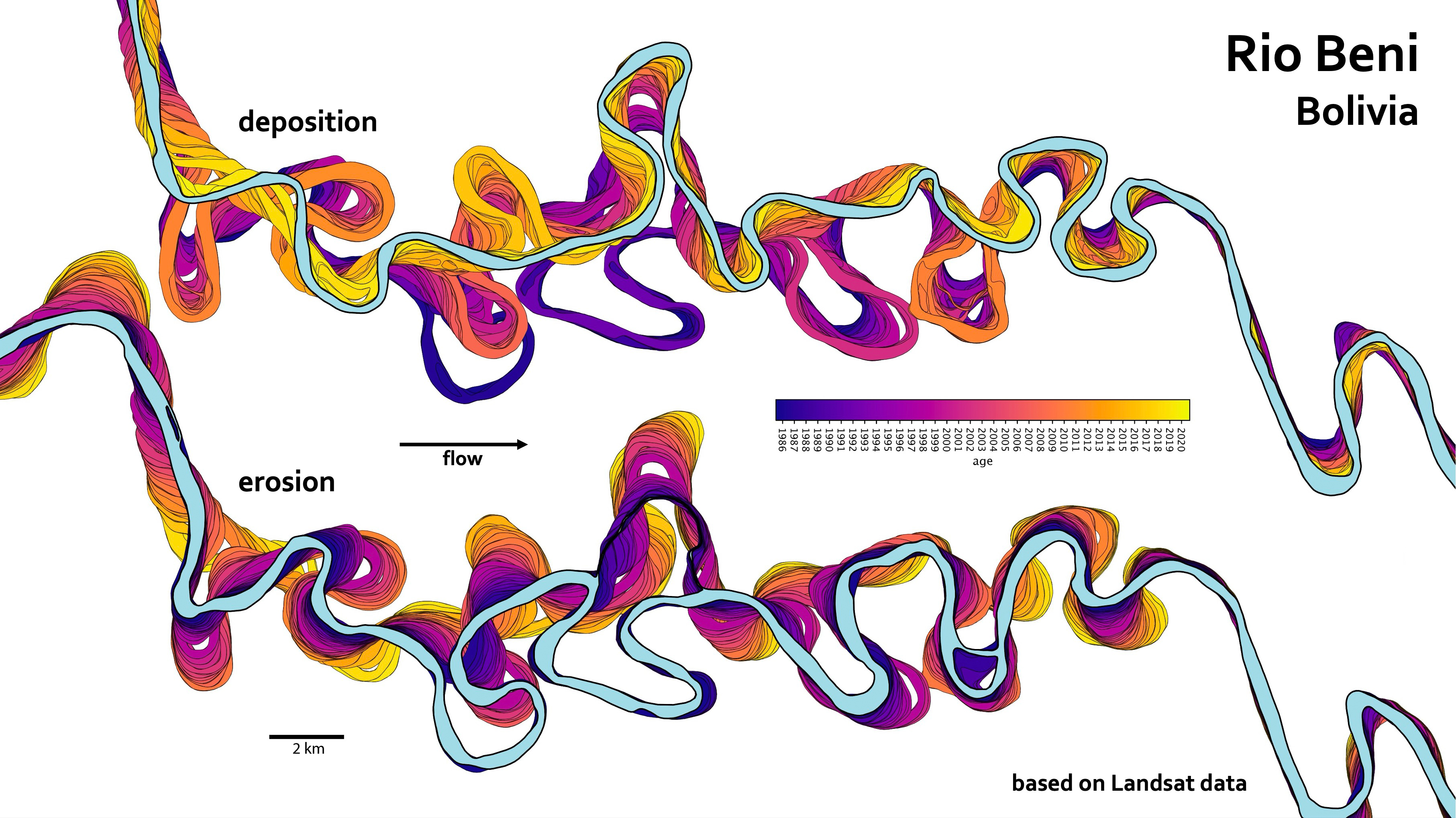
For many years, Research Professor Zoltán Sylvester of the Bureau’s Quantitative Clastics Laboratory has captivated and intrigued scientists and the public alike with his fascinating animations and authoritative papers illustrating the dynamics involved in the migration of rivers. Recently, he and his colleagues have developed a faster, more fully automated software package to map channel banks and centerlines. This tool helps to visualize the evolution of single-thread and multi-thread rivers and to investigate how well simple models of meandering predict channel migration.
Although it has been shown that increasing sediment load correlates with higher migration rates, the impact of sediment load on the plan-view geometry and kinematics of rivers remains largely unexplored. Recent work by Sylvester and his colleagues suggests that in rivers with low sediment loads, point-bar accretion is more uniform in time and closely matches erosion; curvature-based models predict migration rates well. The morphology and stratigraphy of the inner banks is relatively simple. In contrast, high sediment loads result in the rapid growth of bars that are accreted to the inner bank. Bank accretion is episodic and bar morphology and stratigraphy are complicated; simple curvature-based models of meandering are less predictive.
Their simple framework explains a broad range of observations across a variety of river morphologies by placing them in the context of curvature-based models of channel migration and variable sediment load. This research was presented at the 2025 American Geophysical Union Annual Meeting in a talk entitled “Accreting, fast and slow: How sediment load sets the pace and geometry of meandering.”
For more information on this work and the research of the Quantitative Clastics Laboratory, please contact Zoltán Sylvester.

