
A nationwide assessment of CO₂ storage potential in U.S. underground natural gas storage facilities
Fuel, 416, 138557, 2026
https://doi.org/10.1016/j.fuel.2026.138557
Study Summary
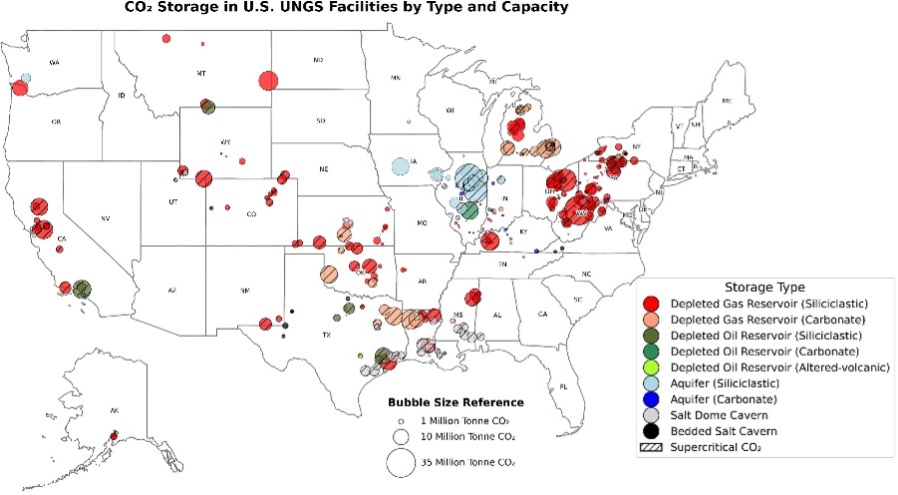
Underground natural gas storage (UNGS) facilities in the United States currently hold approximately 9.2 trillion standard cubic feet of natural gas and have demonstrated long-term containment and operational reliability. Conversion of UNGS sites may be considered in scenarios such as when a storage field nears the end of its operational gas storage life or when there is a strategic need to expand CO₂ storage capacity near major emission hubs. Repurposing them for CO₂ storage offers a pathway to extend the economic life of existing infrastructure, create new revenue streams through mechanisms such as the U.S. 45Q tax credit. This study presents the first nationwide, field-level assessment of U.S. UNGS reservoirs, aquifers and salt caverns for CO₂ sequestration. A comprehensive database of 384 facilities (447 depleted hydrocarbon reservoirs, aquifers and salt caverns), was compiled, capturing storage capacity, injectivity, subsurface characteristics, and proximity to point-source CO₂ emitters. These sites were classified into nine storage classes based on lithology, native fluid, and cavern type. U.S. UNGS sites are estimated to have a storage capacity of approximately 1 gigatonne of CO₂, including 0.82 gigatonnes in 244 sites capable of storing supercritical CO₂. Sensitivity analysis suggests that modest pressure increases (10–30%) could raise total CO₂ storage capacity from ∼0.98 gigatonnes to ∼1.1–1.4 gigatonnes, including ∼0.91–0.98 gigatonnes of supercritical CO₂. This storage capacity could accommodate roughly half of a single year’s emissions from U.S. point sources (∼2.21 gigatonnes), highlighting the role of UNGS facilities as a strategic “buffer” for early-stage carbon capture and storage (CCS) deployment. Combined site injectivity is estimated at ∼4.15 million tonnes per day, with ∼3.3 million tonnes per day available from supercritical CO₂ injection. Storage capacity, field-level injectivity, and per-well injectivity were further analyzed statistically by storage class. Spatial analysis also shows strong regional correlations between emissions, storage capacity, and injectivity, indicating that regions with the largest emissions offer the highest storage potential.
Why is this research important and why do the results matter?
- First nationwide, field-level assessment of CO₂ storage potential in U.S. UNGS facilities.
- U.S. UNGS sites could store up to approximately 1 gigatonne of CO₂.
- Combined injectivity estimated at ∼4.15 million tonnes/day.
- Strong alignment between CO₂ emissions, storage capacity, and injectivity.
Link(s):
Mirzaei-Paiaman, A., 2026. A nationwide assessment of CO₂ storage potential in U.S. underground natural gas storage facilities. Fuel, 416, 138557. https://doi.org/10.1016/j.fuel.2026.138557

