Bauxite Mines and Red Mud in Jamaica: Sources for Rare Earth Elements
Simon Mitchell is a Professor of Sedimentary Geology at the University of the West Indies in Mona, Kingston in Jamaica. This podcast focuses on his work mapping bauxite mines and assessing red mud tailings as potential sources of Rare Earth Elements (REEs) in Jamaica.
Highlights
Bauxite Mines in Jamaica
- Jamaica has been an important global source of bauxite for more than 70 years.
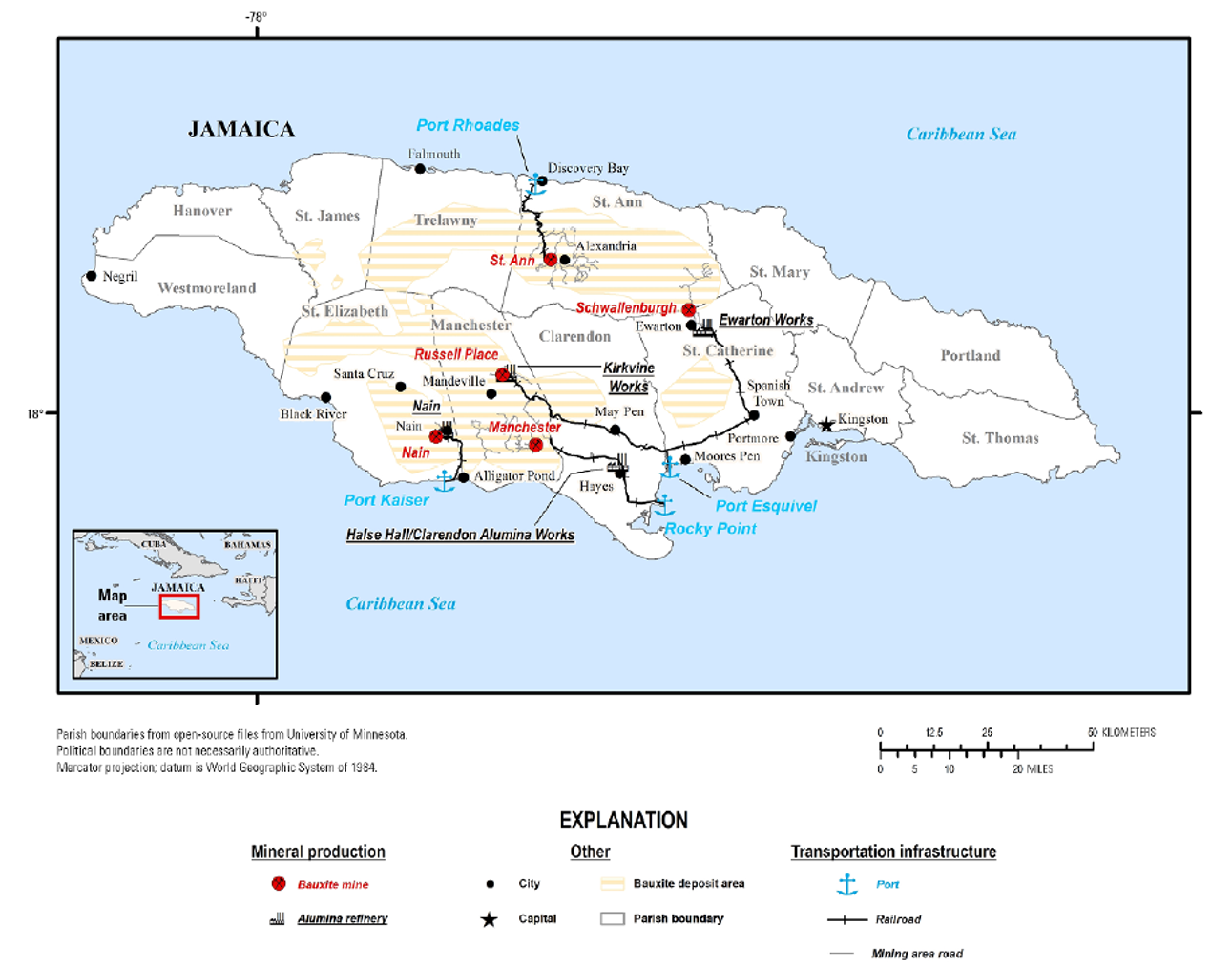
Although aluminum-rich soils were recognized in Jamaica as early as the 19th century, commercial development accelerated during World War II when surveys identified the country's soils as unusually rich bauxites. Alcan was one of the first major companies to establish operations in Jamaica in the 1950s, followed by other companies as ownership of mining assets changed over time. The locations of bauxite mines are shown in Fig. 1. - Jamaica's bauxite industry developed around two fundamentally different production systems:
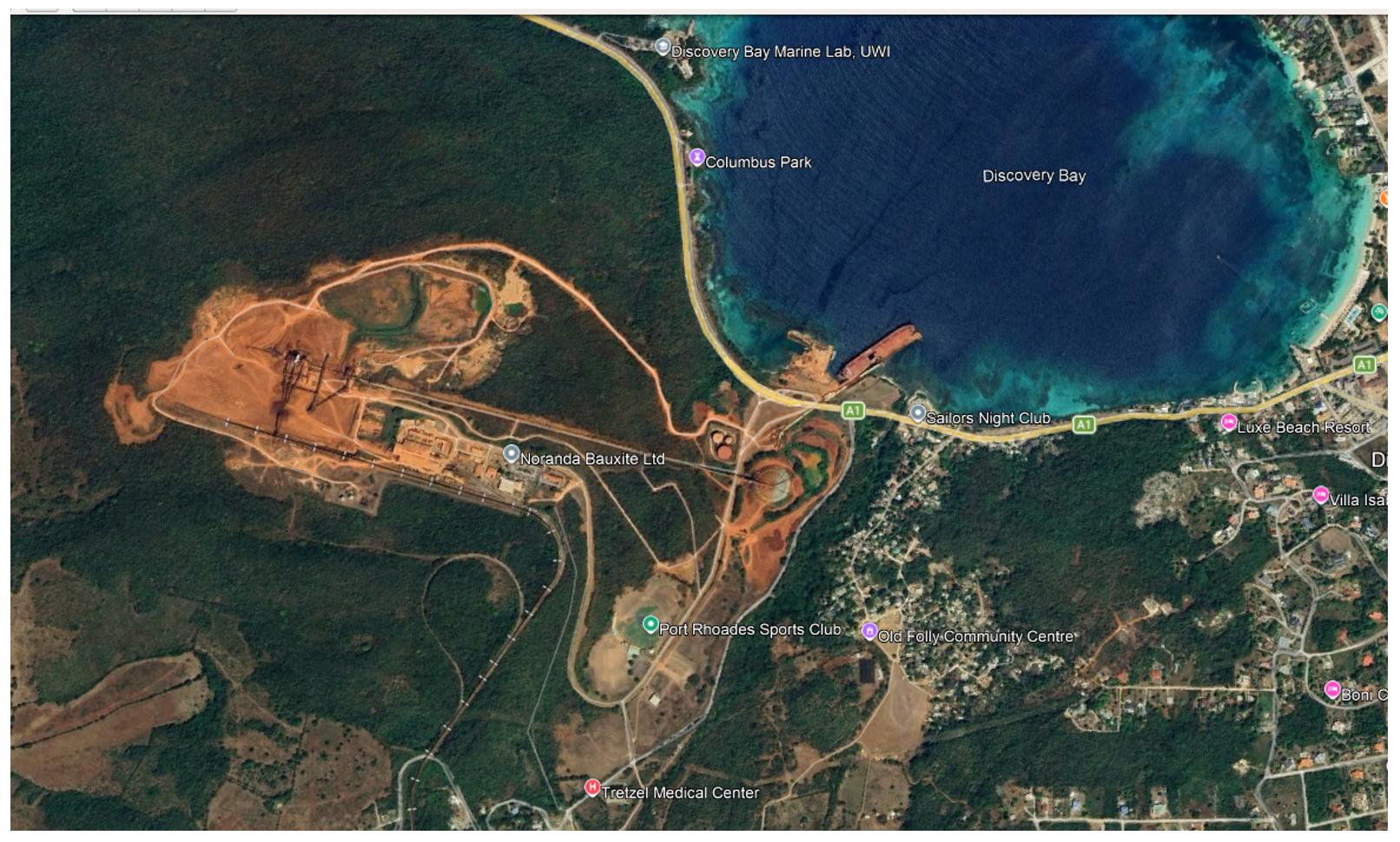
- Some companies mine bauxite and export the ore to other countries, where it is processed for alumina (Fig. 2, port in Discovery Bay).
- Other companies process the bauxite in Jamaica to produce alumina, which is subsequently exported for aluminum smelting. These operations accumulate bauxite residue, also termed “red mud” as tailings at these sites.
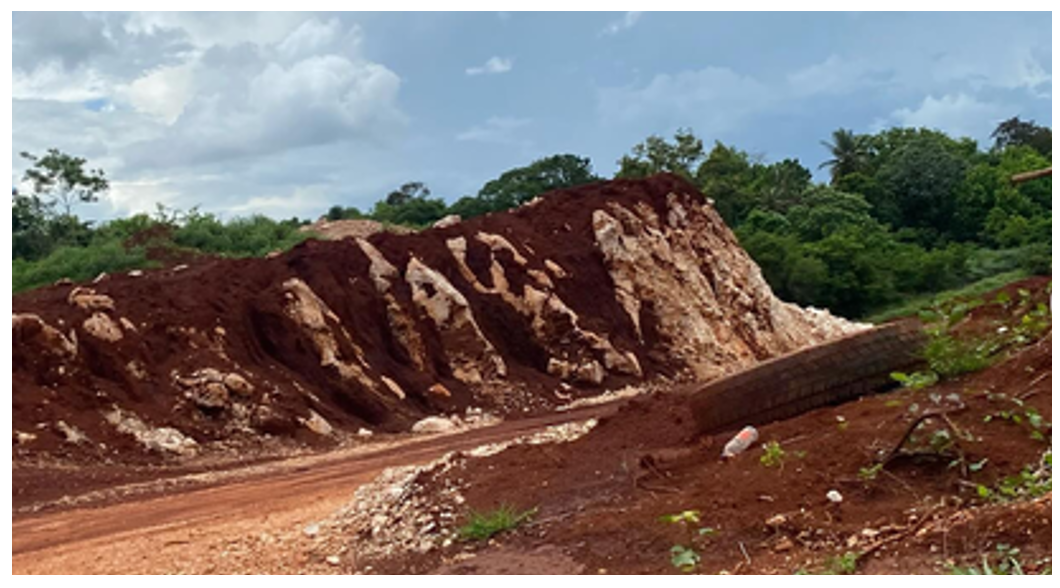
- The location of Jamaica’s bauxite deposits is strongly controlled by its distinctive karst geology, termed “cone karst”. The White Limestone ranges from Miocene to Holocene and forms the “Cockpit Country” in central Jamaica (link). Bauxite occurs primarily in depressions developed in relatively soft white limestone (Fig. 3). The landscape resembles an "egg box," with residual limestone hills surrounding depressions where bauxite accumulated. Deposits are therefore highly localized rather than forming continuous layers across the landscape.
- The geology explains why some areas are economically mineable while adjacent areas are not.
- Deposits in softer limestone can occupy depressions roughly half a kilometer across and extend 20 m or more in depth.
- Where limestone becomes harder or changes to dolostone, the depressions become smaller and the bauxite deposits are generally too small to justify mining. Mining commonly stops at the geological boundary between the softer limestones and harder dolostones.
Origin of Bauxite in Jamaica
- The unusual REE enrichment may be related to the volcanic origin of much of Jamaica's bauxite-forming material (Comer, Econ. Geol.,1974). Simon describes evidence that large explosive volcanic eruptions in Central America supplied ash that was transported through the atmosphere and deposited across Jamaica. Geochemical evidence from ash layers and zircon ages supports this interpretation. The volcanic ash subsequently accumulated in karst depressions, underwent intense weathering and leaching, and evolved into bauxite. Simon suggests that the original volcanic material itself may have been enriched in REEs, potentially helping explain their concentration in the resulting bauxite and red mud.
- The geological history indicates that Jamaican bauxite is not simply a residue left behind by dissolution of limestone. An older hypothesis proposed that bauxite formed through dissolution of the underlying limestone, leaving behind residual aluminum and iron. Mitchell argues against this because Jamaican limestones are exceptionally pure—about 99.8%—and bauxite occurs on younger limestone surfaces where there was insufficient underlying limestone available to generate the observed deposits. The evidence instead favors externally supplied material, particularly volcanic ash, combined with weathering and karst processes.
Alumina Production and Red Mud Tailings
- The Bayer process transforms bauxite to alumina and bauxite residue, also termed red mud, that is stored nearby in lakes or tailing ponds. Bauxite is crushed and treated with hot, concentrated sodium hydroxide. Aluminum-bearing minerals dissolve into a sodium-aluminate solution, while iron oxides, heavy minerals, REEs, and other constituents—including minerals containing REEs—remain in the solid residue. The residue is separated in settling tanks and filters, producing the material known as red mud.
- The Bayer process (assuming gibbsite) can be represented as:
Digestion: Al(OH)3 + NaOH → NaAl(OH)4 (heated at T 150 – 200°C)
Clarification: (Separation) with dense particles separating from the mix as red mud, leaving concentrated sodium aluminate NaAl(OH)4 liquor]
Precipitation: NaAl(OH)4 → Al(OH)3↓ + NaOH
Calcination: Aluminium hydroxide heated to high temperatures (~ 1,000 C) in kilns or calciners to remove water and yield pure alumina 2Al(OH)3 → Al2O3 + 3H2O
The Hall-Héroult process is then used to convert alumina to aluminium metal. - The Bayer process is energy intensive. A 2023 life-cycle-analysis of European refineries suggested ~9 – 11 GJ/tonne of alumina (Saez-Guinoa et al., IJLCA, 2024).
- Energy availability and cost are now major factors determining whether Jamaica processes bauxite locally or exports it. Jamaica has historically relied heavily on hydrocarbons and does not have the low-cost energy resources available to support alumina production. There were discussions with Trinidad but they did not result in increased energy access. Rising or volatile fuel prices have therefore contributed to the decline or mothballing of several Jamaican alumina-processing facilities.
- Jamaica has renewable-energy opportunities but integrating them with the bauxite industry is challenging. Simon indicates that there is substantial potential for offshore wind, particularly around the shallow Pedro Bank, as well as solar and some hydropower. However, large solar facilities require significant land, while the bauxite industry is concentrated on limestone areas that generally lack rivers suitable for hydropower. Public opposition can also constrain energy development.
- Jamaican bauxite contains ~ 50% alumina (Kyle et al., 2026; Patterson et al., 1986). Removing the alumina by the Bayer process would result in concentrating the remaining constituents by about 2 × because these constituents are retained in the bauxite residue, also termed red mud. The red mud has high concentrations of iron, titanium, and critical minerals, including REEs. This concentration effect is one reason historical red-mud deposits are now being reconsidered as potential secondary mineral resources.
Three major companies have historically produced alumina in Jamaica and generated the country's major red-mud lakes.
- Jamalco (Jamaica Aluminium Company),
- Windalco (West Indies Aluminium Company), and
- Alpart (Aluminium Partners of Jamaica)
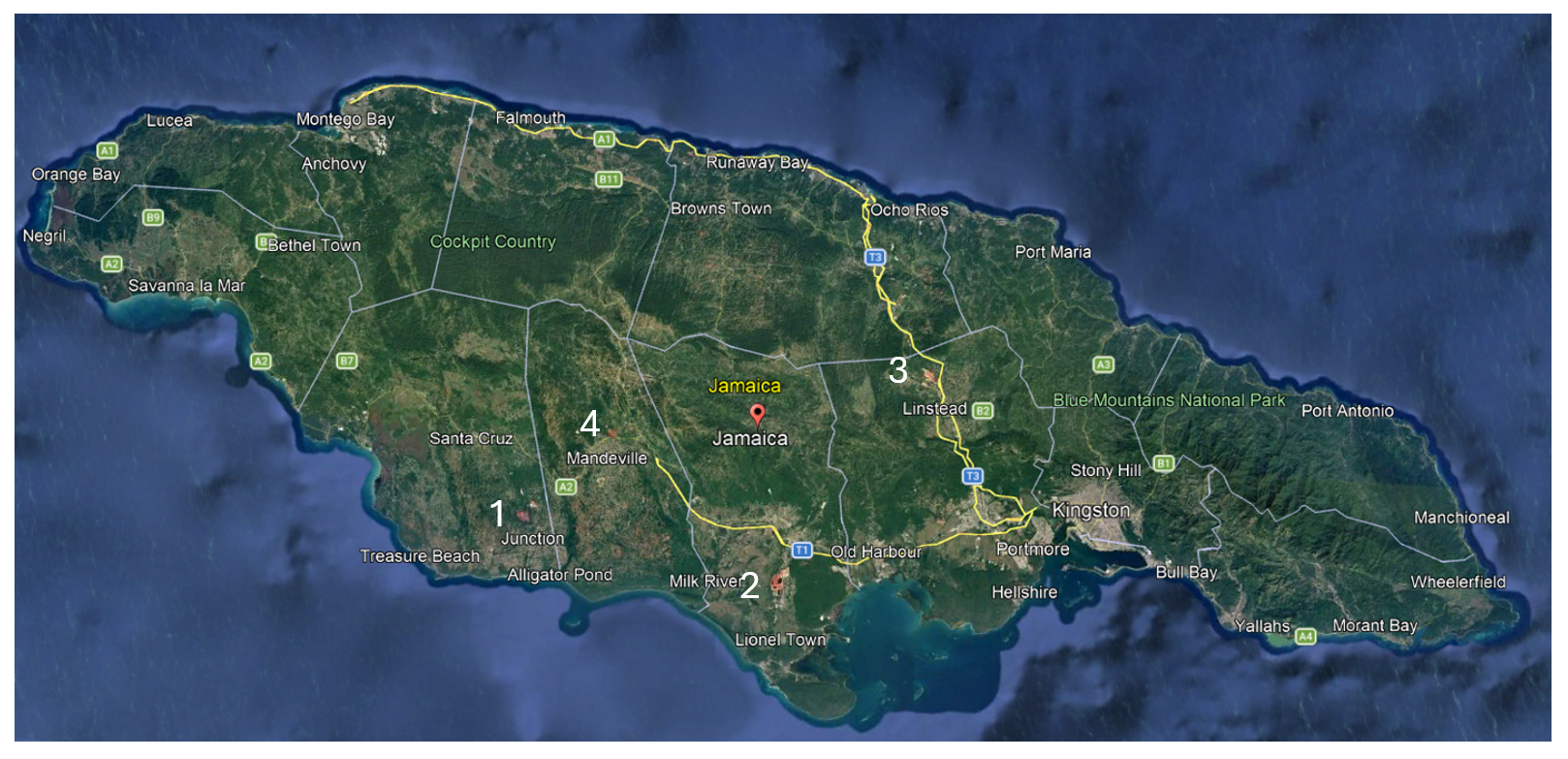
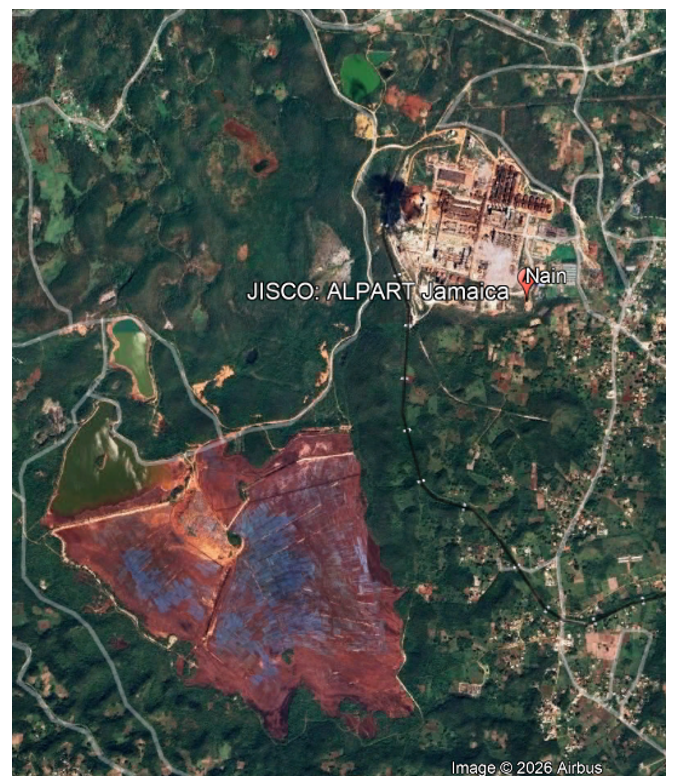
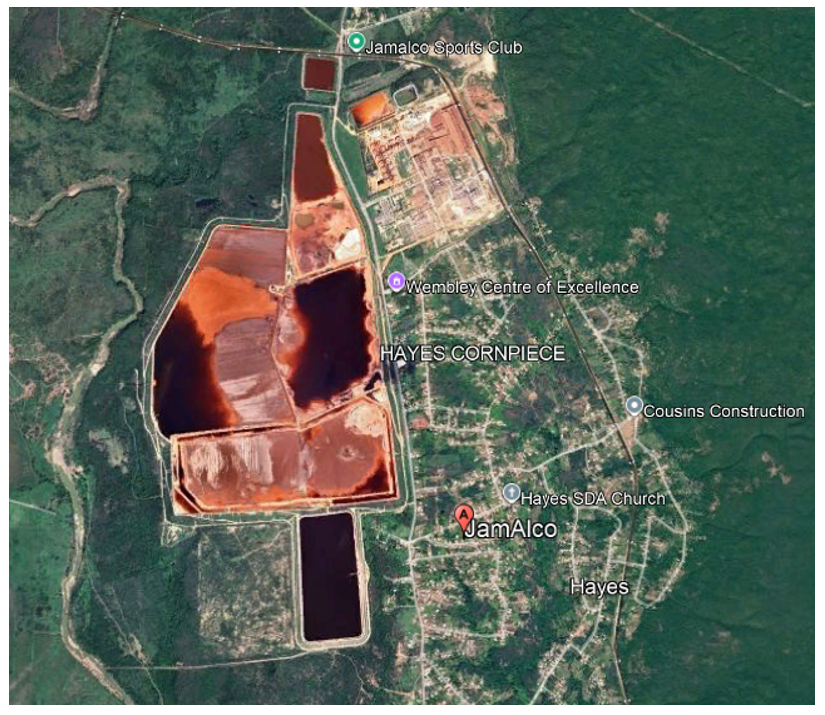
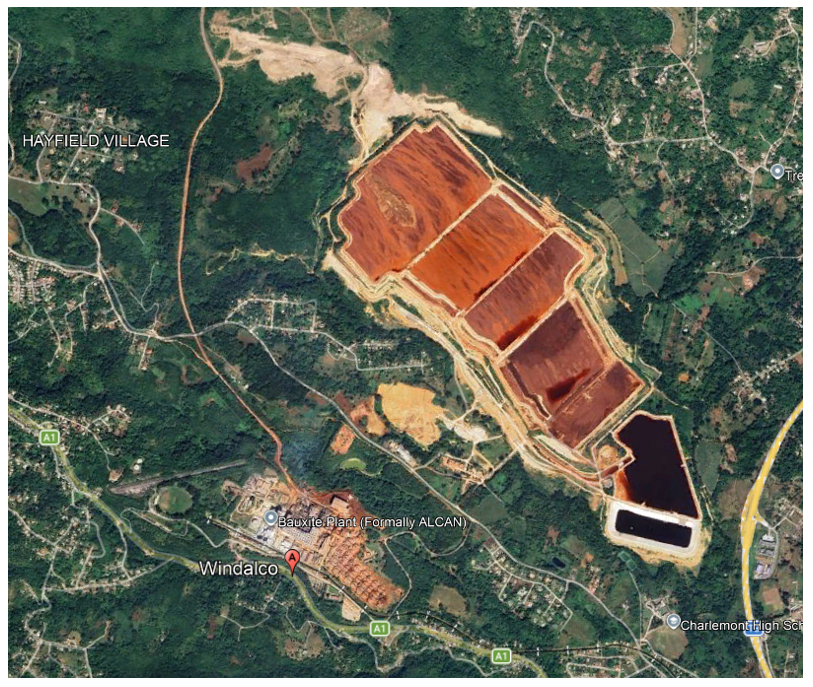
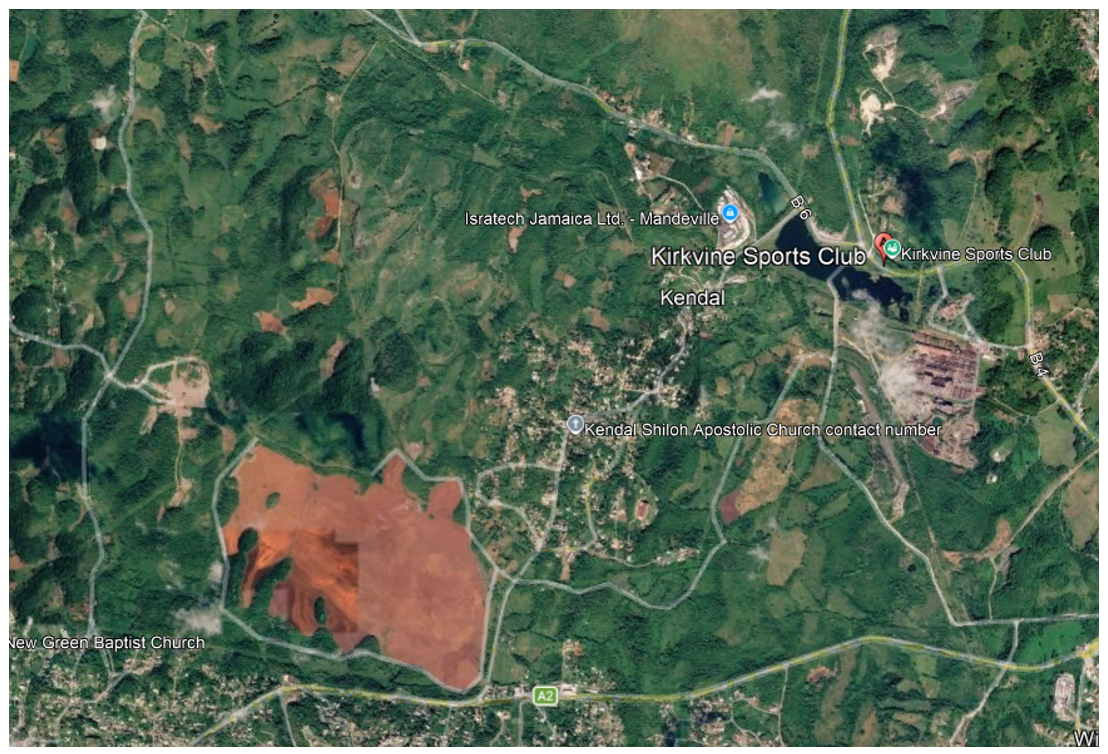
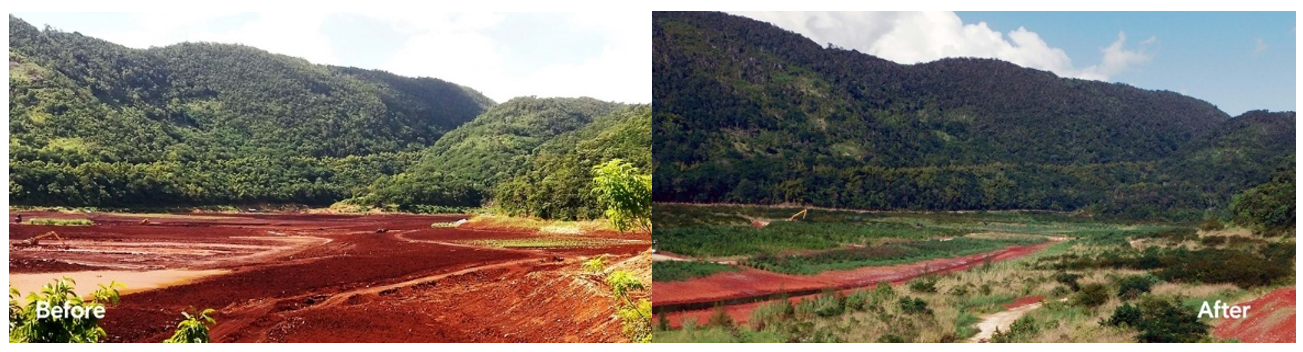
These operations generated four major red-mud lakes (Fig. 4-6), and one, near Mount Rosser, has subsequently been reclaimed and restored as a wetland (Fig. 7).
- Red mud presents a significant environmental challenge because it is highly alkaline.
The residual material can have a pH of ~11–12 because of the sodium hydroxide used during processing. Simon emphasizes that the material is sufficiently caustic that the effects can be noticeable around large red-mud storage areas. In Jamaica, the potential for alkaline solutions to reach the underlying limestone aquifer has been an important environmental concern; however, clay liners of the storage areas generally protect underlying aquifers. - Jamaica's red-mud lakes represent a potentially enormous secondary resource.
The tailings-storage areas associated with the alumina plants can extend for several kilometers and contain very large volumes of material. Alumina production in Jamaica is estimated to be ~ 130 million tons (World Minerals Stats. Data) and potentially similar amount of red mud, illustrating the scale of the accumulated resource. - Bauxite was imported from Jamaica and converted to alumina at sites along the Gulf Coast (Kyle et al., 2026). Results from the Copano site in Texas from 3 samples average around 2,000 ppm total REEs plus yttrium, compared with an average crustal value of roughly 200 ppm—about 10 times crustal abundance. Both light and heavy REEs are highly elevated relative to average crustal levels.
Environmental Concerns
- Recovering REEs and other critical minerals from red mud could simultaneously address resource security and environmental remediation—but only if the process avoids creating another waste problem.
Jamaica has already demonstrated that REEs can technically be extracted from red mud. A pilot-scale separation effort associated with Japan successfully recovered REEs, but high energy costs prevented the process from becoming economically viable. A major remaining challenge is what to do with the residual material because processing can concentrate uranium and other potentially radioactive elements. Simon emphasizes that a successful future strategy should clean up existing red-mud lakes rather than simply transform one waste stream into another. Recovering REEs, iron, and other valuable materials while minimizing and safely managing the final residual waste could therefore provide both economic and environmental benefits. - Water security is directly connected to red-mud management. Jamaica's red-mud storage areas are located above an open limestone aquifer, making containment essential. The historical lakes have been lined with clay and monitored with nearby wells; Simon reports that no significant leakage has been detected to date.
- Mine reclamation is a second major environmental issue. Removing 20–30 m of bauxite from natural karst depressions leaves substantially deeper depressions. Current rehabilitation commonly involves revegetating the disturbed areas and, in some cases, using them for cattle grazing. The Mount Rosser site indicates that it is feasible to revegetate these sites.
General Issues
- Mineral rights could be important for future critical-mineral development. In Jamaica, metallic mineral rights are controlled by the government, while companies receive licenses to explore and potentially develop resources. Bauxite companies' rights to extract aluminum do not automatically give them rights to explore for other minerals, such as REEs, creating opportunities for separate exploration companies. The Jamaican Bauxite Institute partnered with Japan based Nippin Light Metal and with local exploration companies, such as Geophysx Jamaica (Bobby Stewart) to assess the feasibility of extracting REEs from red mud ponds.
- Simon has spent about 30 years mapping and studying Jamaica's geology and training students from Jamaica and across the English-speaking Caribbean. Former students now contribute to environmental, water-security, mineral-exploration, and other sectors.