
CO₂ Cushion Gas Replacement in U.S. Underground Natural Gas Storage: A Facility-Level Analysis of Sequestration, Cushion Gas Recovery, and Working Gas Storage Expansion
Energy and Fuels,40,15069−15090, 2026
https://doi.org/10.1021/acs.energyfuels.6c01555
Study Summary
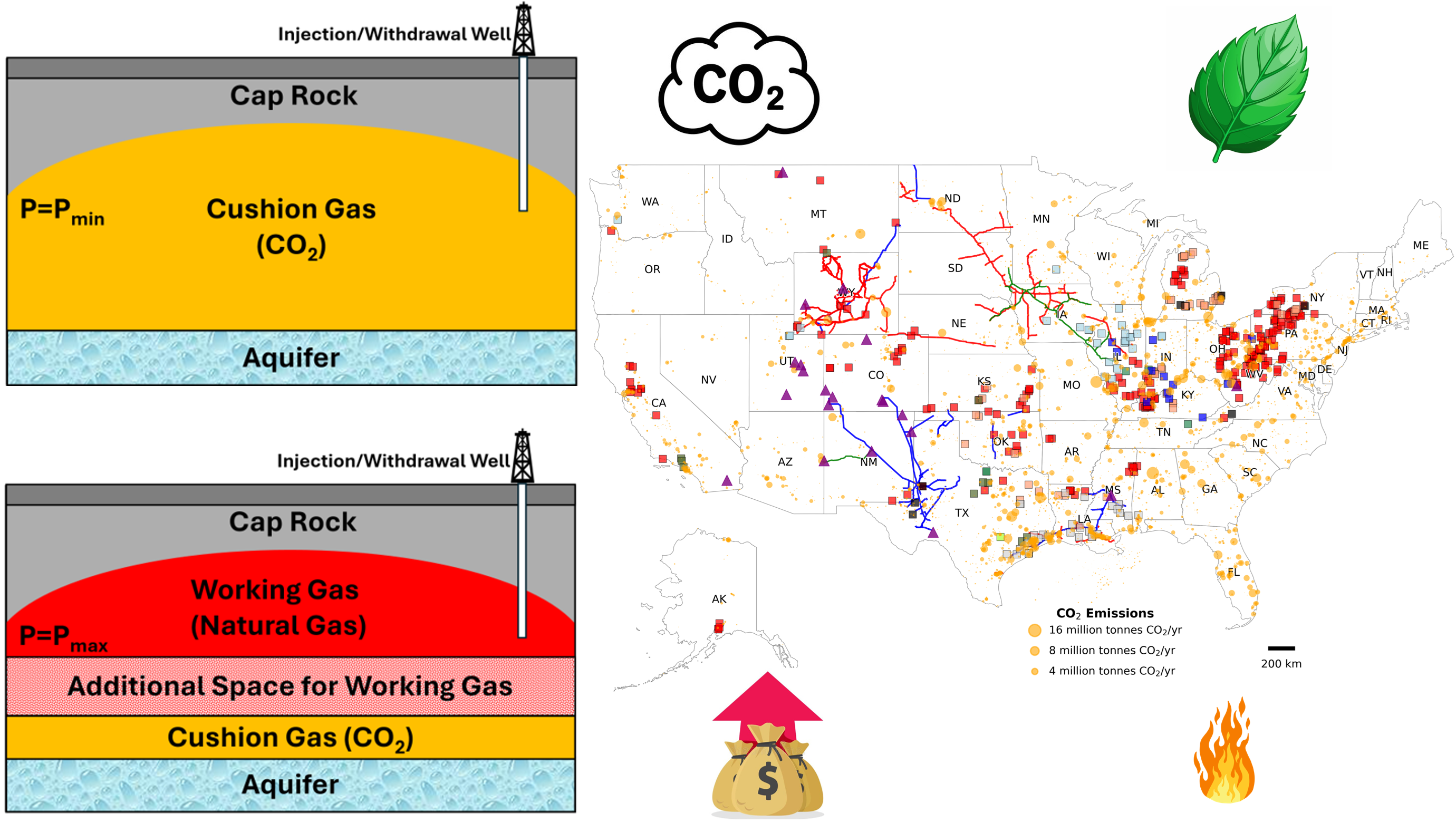
Underground natural gas storage (UNGS) facilities in the U.S. store ~9.2 Tscf of gas in depleted oil and gas reservoirs, saline aquifers, and solution-mined salt caverns, nearly half of which is immobilized as cushion gas. This study presents the first nationwide, site-level assessment of substituting natural gas cushion with the less expensive CO₂, sourced from anthropogenic emissions or geologic reservoirs. This novel CO₂-utilization approach both liberates stranded cushion gas and expands working gas storage space within existing infrastructure, driven by CO₂’s greater compressibility under typical storage conditions. When sourced from anthropogenic emissions, the approach also contributes to climate change mitigation through CO₂ sequestration. A database of 384 U.S. UNGS facilities was analyzed to estimate site-level CO₂ utilization, recoverable cushion gas, and additional working gas storage space, and integrated it with data on CO₂ emitters, geologic CO₂ reservoirs, and CO₂ pipelines. Results indicate that full cushion replacement would require ~0.33 gigatonnes CO₂. Individual facility capacities range from nearly 2,200 tonnes to 19 million tonnes. In 96% of facilities (370 sites), CO₂ substitution increases working gas storage space by 0.3–344% (average 28%), totaling 1,113 Bscf nationwide. Depleted reservoirs and siliciclastic aquifers contribute most, with the Midwest, East, and South Central regions showing highest potential. Even a conservative 20% cushion replacement could utilize ~67 million tonnes CO₂, free ~0.9 Tscf of gas, and add ~223 Bscf of storage space for working gas. Spatial correspondence between UNGS facilities, CO₂ emitters, geologic CO₂ reservoirs, and CO₂ transportation infrastructure indicates potential opportunities for CO₂ sourcing and transport, warranting further site-specific evaluation. These results highlight a scalable strategy to enhance energy storage capacity, monetize stranded natural gas, support climate change mitigation, and create new opportunities for CO₂ utilization.
Why is this research important and why do the results matter?
- A novel CO₂-utilization approach that both liberates stranded cushion gas and expands working gas storage space within existing infrastructure
- The first nationwide, site-level assessment of substituting natural gas cushion with the less expensive CO₂, sourced from anthropogenic emissions or geologic reservoirs
- In 96% of facilities, CO₂ substitution increases working gas storage space by 0.3–344% (average 28%), totaling 1,113 Bscf nationwide
Link(s)
Mirzaei-Paiaman, A., 2026. CO₂ Cushion Gas Replacement in U.S. Underground Natural Gas Storage: A Facility-Level Analysis of Sequestration, Cushion Gas Recovery, and Working Gas Storage Expansion. Energy Fuels 2026, 40, 28, 15069–15090. https://doi.org/10.1021/acs.energyfuels.6c01555

