
Mapping the present-day 2-D crustal stress field and seismic moment release for the Greater Permian Basin of Texas as constrained by earthquake source mechanisms
Dino G.-C. Huang, Yangkang Chen, & Alexandros Savvaidis
Seismica, Vol. 5 No. 1, 2026
https://doi.org/10.26443/seismica.v5i1.1920
Study Summary
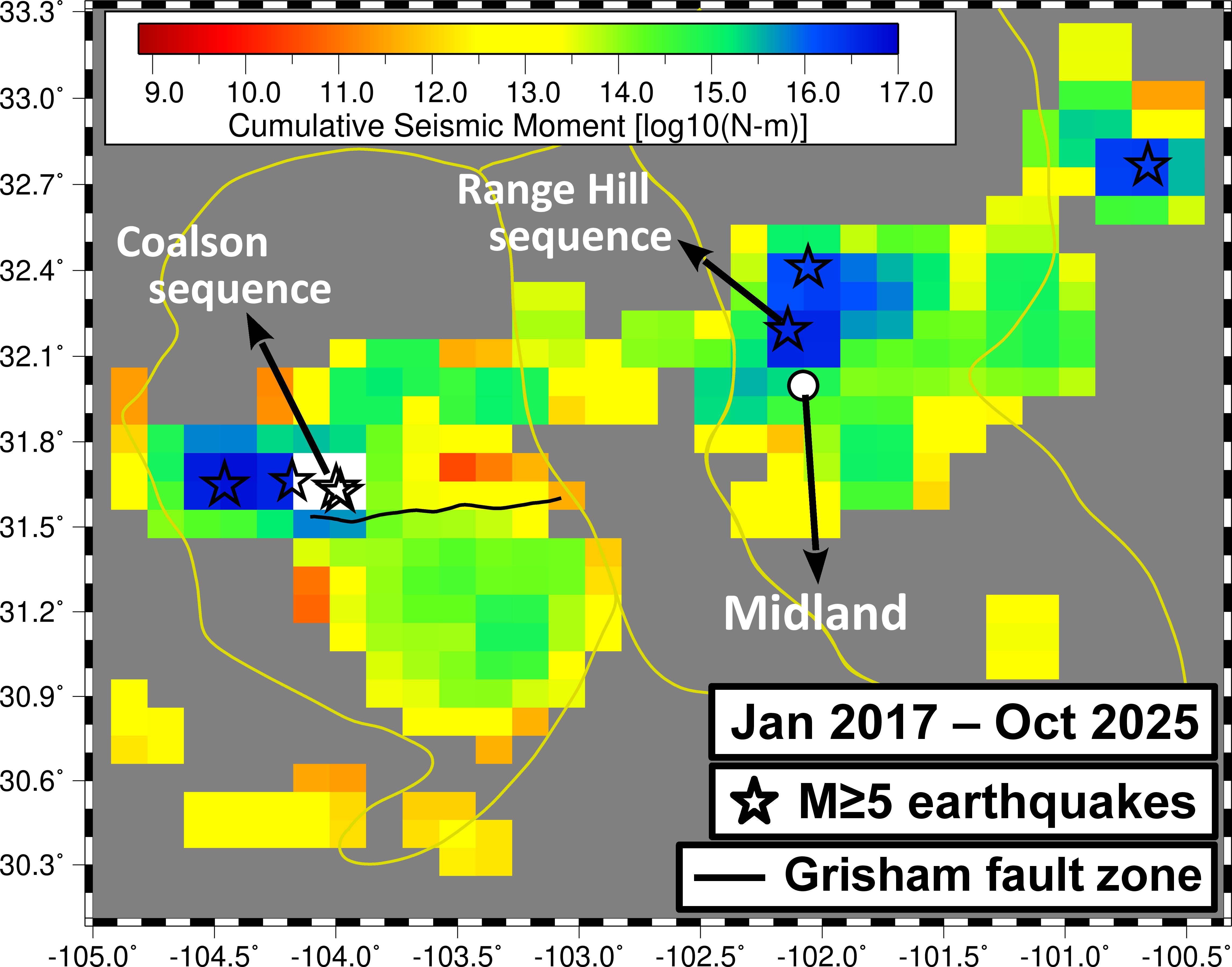
The greater Permian Basin is composed of three major subprovinces – the Delaware Basin, the Central Basin Platform, and the Midland Basin. In the last 10 years, it is well known for induced seismicity. As of Oct 2025, it had over 340,000 M≥1.0 earthquakes. The induced seismicity in the basin has thus generated considerable seismic moment release. Of those M≥1.0 earthquakes, notably seven M≥5 earthquakes have been documented. The spatial distribution of seismic moment and stress pattern can be used as a proxy to assess the crustal deformation caused by induced seismicity. To address the tectonic significance, in this study we collected previously published and newly determined focal mechanisms to invert for the regional stress model of the Permian Basin. Although the inversion results suggest that the Permian Basin contains an extensional stress field in general, the orientations of the principal stress axes are diverse within the basin. This heterogeneity further indicates that the two subprovinces of the Delaware and Midland Basins as well as the basement-rooted fault systems may not be subject to the same stress regime. Despite the fact the induced seismicity has widely distributed in the Permian Basin, the high moment release is concentrated in a zone that bisects the Permian Basin and is linked to the basement-rooted fault systems (Figure 1). Considering the tectonism involved in the creation of the Permian Basin, the fault systems may have been previously stressed throughout an extended period of time. It has constituted a pre-existing elastic strain reservoir that accumulated considerable tectonic strains. Those strains are released by the present-day fault reactivation and induced seismicity. It is worth noting that a major metropolitan area of West Texas, the city of Midland having population of nearly 200K, is in proximity to the zone. Understanding the detailed stress field and seismic moment release is critical for assessing and mitigating seismic hazards associated with fluid injection and hydrocarbon extraction. This knowledge is essential for regulators, operators, and communities to develop more effective risk management strategies and to anticipate areas at higher risk for significant earthquakes and ground deformation.
Why is this research important and why do the results matter?
- Intellectual merit: The research shows that areas with higher seismic moment release correspond to regions with pre-existing, highly stressed basement-rooted faults, indicating a long-term accumulation and episodic release of tectonic strain. This work leverages a large, newly compiled set of earthquake focal mechanisms to achieve high spatial resolution in mapping the stress field.
- Broader impacts: The findings reveal that induced seismicity is not just a function of current industrial activity but is strongly influenced by the structure of reactivated pre-existing faults. This finding highlights the importance of a recently funded TexNet project – Earthquake Early Warning system of Texas.

