
Bureau Researcher Explores Subsurface Composite Confining Systems
Subsurface geology offers vast storage capacity for a variety of industries including oil and gas exploration, temporary oil and natural gas storage, groundwater storage, geothermal energy, critical minerals, industrial waste disposal, and CO2 disposal. For all of these, containment is key. Successful oil production requires trapping on geologic timescales. Preserving drinking-quality freshwater aquifers requires separation from naturally occurring hydrocarbons and saline brines, and successful wastewater disposal requires that injected fluids remain safely separated from freshwater aquifers and producing hydrocarbon fields.
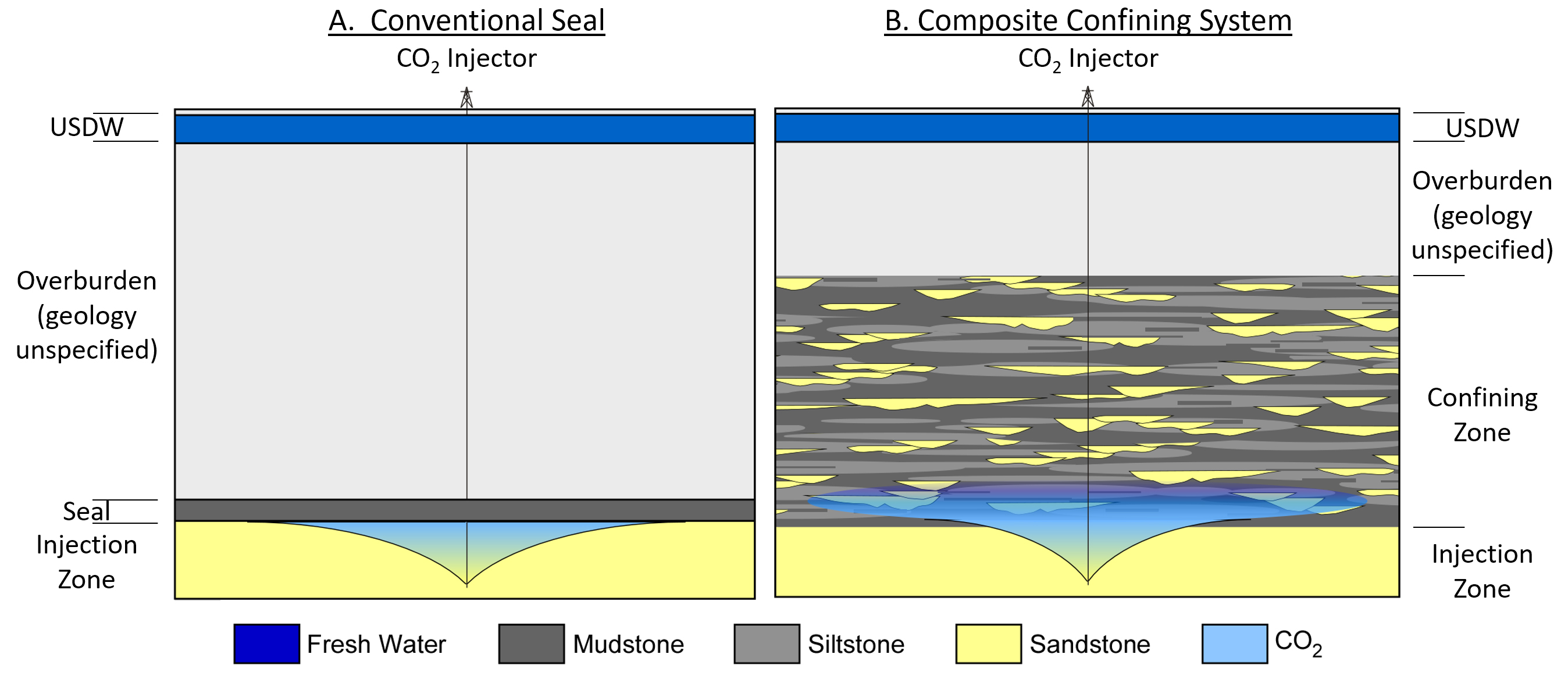
For several years, Bureau Research Associate Professor Dr. Alex Bump and colleagues have studied the concept of composite confining systems. Hydrocarbon accumulations prove that geologic seals can retain buoyant fluids for millions of years. Historically, subsurface waste disposal has taken a cue from the oil and gas industry and relied on the same sort of geologic seals: laterally extensive, very low-permeability layers, typically clay-rich mudstones and evaporites. Those seals are effective, but the preference for them is based on the need for production in oil and gas. Low-permeability seals can retain large volumes of concentrated, mobile fluids. By analogy, these seals are like a metal bucket used to contain drinking water; the steel of the bucket is a very low-permeability layer that allows you to securely hold and recover a certain volume of water.
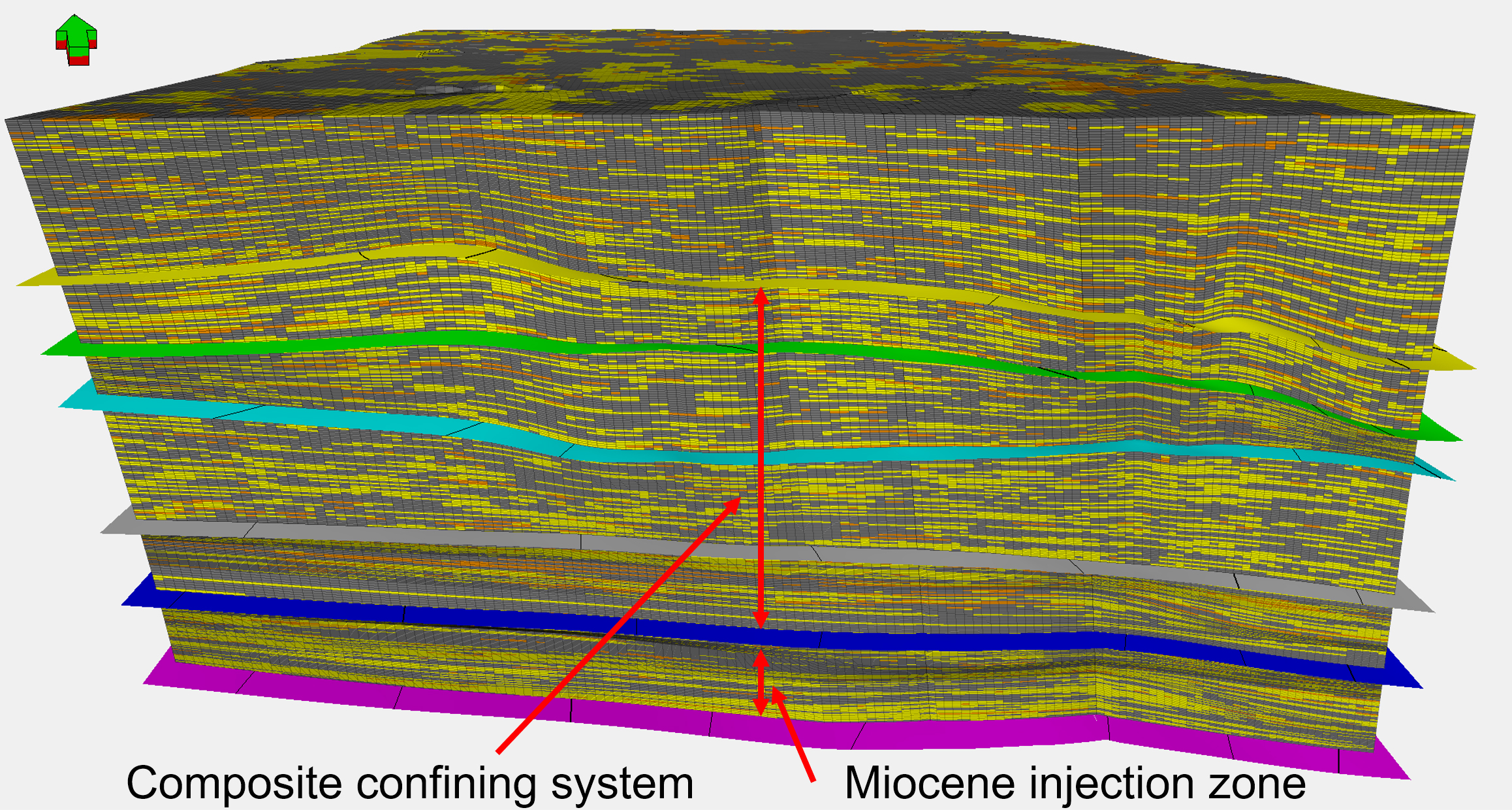
However, if the goal is permanent disposal, do you need a "bucket"? A stack of towels or a box of cat litter would do the job, and they might even be better; unlike a bucket, neither can spill if accidentally kicked over. That is the idea behind composite confinement, a strategy for permanent disposal first proposed by Bump et al. in 2023. In geologic terms, they proposed that a thick stack of discontinuous barriers to vertical flow could provide secure containment with no requirement for the lateral continuity or specific permeability of individual barriers. Each barrier need only be sufficient to divert the upward flow of buoyant fluids. In aggregate, the stack of barriers, like a stack of Swiss cheese slices, creates a very long, tortuous flow path for buoyant fluids that “soaks up” the injected fluids. In oil and gas, it’s called “migration loss” because fluids thus trapped are unrecoverable. In the context of disposal, unrecoverable “loss” is secure containment.
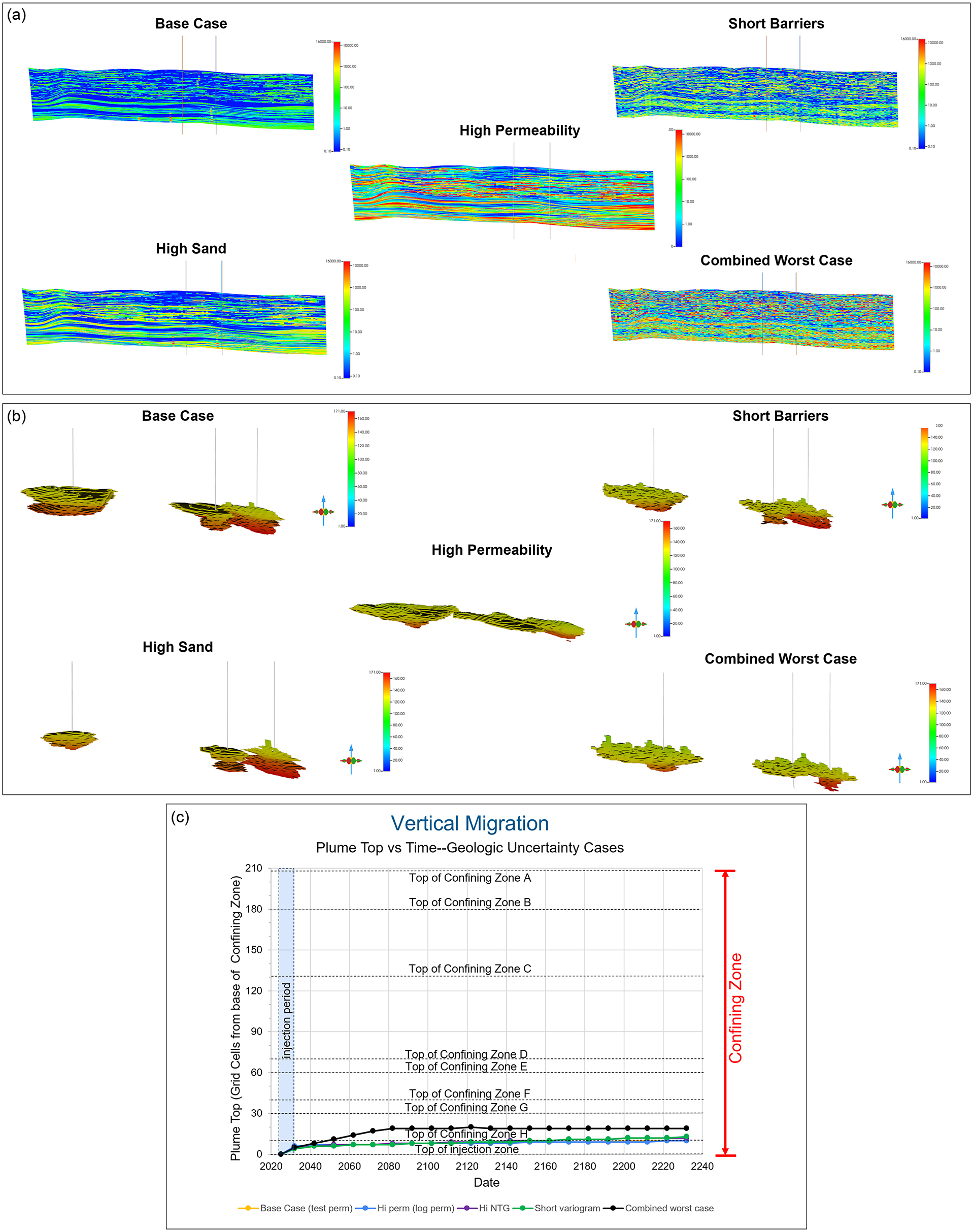
The concept has attracted considerable attention, as it opens vast new areas for disposal, and may offer more secure containment, but the recurring question has been how to ensure or derisk it. New research addresses that question. Using an exceptionally well-characterized Gulf Coast storage site with approximately 160 historic wells, and 3D seismic surveys, Bump and colleagues were able to precisely define distribution functions for the key variables. They then built reservoir models populated with the statistical worst-case values, and injected digital CO2 to see how the geologic uncertainty might impact containment. Even in the combined worst-case scenario (i.e., all variables with worst-case values) CO2 penetrated only about 10% of the way through the defined confining zone. Using that worst-case model, they then experimented with over-injecting, testing the margin of safety. At 10 times the planned injection volume, CO2 reached the lateral edge of the model, with 70% of the confining zone still above it. In other words, the vertical containment has a safety factor much greater than 10. Should an operator over-inject by that much, the risk is not vertical containment, but lateral migration onto neighboring tracts of land. That’s a potential lawsuit, but no danger to the environment or to human health.
Dr. Bump's research focuses on the application of petroleum exploration processes to the problem of finding, de-risking and developing geologic storage sites. Combining ideas from geology, physics and reservoir engineering with an explorer’s need to see the big picture and find the opportunities, his work has yielded a series of new concepts, including composite confining systems.
For more information, please contact Dr. Alex Bump.

