
Introduction to Carbonate Environments, Facies, and Facies Tracts
Robert G. Loucks, Charles Kerans, and Xavier Janson
Bureau of Economic Geology
| Design Objectives |
| Credits |
| Back |
| Top |
| Exit |
 |
 |
 |
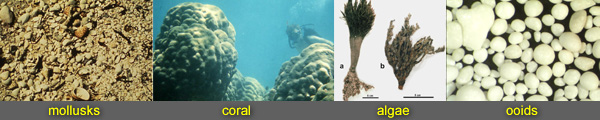
CARBONATE PRODUCTION Click on thumbnails or terms in blue to see captioned photo examples. |
 |
Carbonate
sediments are mainly produced in warm, clear, shallow water where
the water is of normal salinity, light penetration is good, and
clastic sediment input is lacking to minor. The carbonate sediments
form from the bodies of calcareous animals (mollusks,
coral, etc.) and plants (algae)
as well as from chemical precipitation (ooids,
some lime mud, etc.). Erosion of previously deposited carbonate
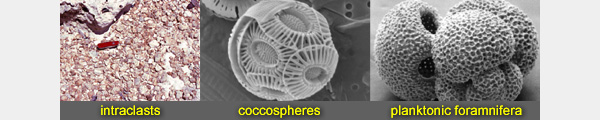
sediment can form detrital carbonate clasts (intraclasts,
grapestone, lithoclasts, etc.). Because most of the carbonate
production takes place on the shallow platform, it has been called
the “carbonate factory” by James (1979). The sediment
produced on the shallow shelf can be transported landward by storms
and seaward by storms and/or gravity-flow mechanisms. Since the
Mesozoic, carbonate sediment has also been generated in the shallow
water column of the deep ocean. Coccospheres
(algae) and planktonic
foramnifera became abundant after this time and
after death the shells sink to the basin floor and form thick
deposits of very fine-grained carbonate sediment called “chalk.” |
 |